All about mouth

Seeing the world through the mouth

Author: daon9n10@gmail.com

  • When the Mouth Became a Medical Object

    For thousands of years, the mouth was a site of display—
    a résumé, a rite of passage, a public declaration of arrival.
    Gold-covered teeth, sharpened canines, embedded gems:
    the mouth spoke before the person did.

    At some point, we stopped seeing it that way.

    The mouth became something to manage, correct, and examine—
    less a speaking organ than a monitored one.

    This wasn’t merely a change in fashion.
    It marked a shift in how the body itself was understood.


    1. Hygiene as a Standard of Judgment

    Modern medicine arrived with a powerful concept: hygiene.

    It brought undeniable progress.
    Pain decreased. Infection was controlled.
    The mouth became more durable and reliable.

    The change became clear when hygiene shifted
    from a way of explaining the body
    to a standard by which it was judged.

    What once signified status or identity—
    a gem set into a tooth—
    was reinterpreted as “an environment favorable to bacteria.”

    • Gold on teeth? ❌ Risk
    • Decoration? ❌ Unhygienic
    • Individuality? ❌ Requires clarification

    Every structure inside the mouth was re-examined
    through the lenses of function and cleanliness.

    Beauty, too, was redefined.
    Ornamentation gave way to
    white, straight, well-maintained teeth.

    The mouth became less a stage for expression
    and more a report card for hygiene.


    2. The Thin Line Called “Normal”
    Medicine undeniably improved quality of life.
    Chewing stabilized. Pain receded. Comfort became routine.

    At the same time, it introduced
    a precise and quietly powerful idea of normal.

    The moment we sit in the dental chair,
    our stories begin to be organized into chart entries.

    What was once a personal feature
    is translated into a condition to be addressed.

    The line doesn’t accuse.
    It simply states: This can be helped.

    Today, we rarely ask,
    “What will my mouth say?”
    Instead, we check:

    • Is this within the normal range?
    • Is the bite functionally sound?
    • Is this cosmetic—or medically justified?

    Individuality, once translated into medical language,
    is quietly filed away.


    3. Desire Didn’t Disappear. It Learned Medical Language.

    Human desire for ornamentation never vanished.
    It simply learned how to explain itself better.

    We now say:

    “Looking better is just a bonus.
    The doctor said it’s functionally beneficial too.”

    The language of “health”
    is the softest mechanism for turning desire into a choice.

    Orthodontics, veneers, whitening—
    are these purely functional interventions,
    or ornamentation legitimized by medicine?

    Desire wasn’t rejected.
    It simply acquired consultation scripts and insurance codes.


    Conclusion: What We Gained—and What Remains Open

    When the mouth became a medical object,
    we gained comfort, longevity, and relief from pain.
    These are real achievements.

    But in the process,
    stories, excesses, and imperfect expressions
    were neatly organized into clinical data.

    The unease we feel when encountering grillz or bold piercings
    isn’t because they are merely unusual.

    It’s because they attempt something subtle:
    to speak again from within the medical frame,
    rather than outside it.

    The mouth still wants to speak.

    The question that remains is simple:

    After being managed and measured,
    can it still say something of its own?
  • When Did We Start Decorating the Mouth?

    People often think of decorating the mouth
    as a modern indulgence—
    a matter of vanity or fashion.

    But this idea doesn’t survive
    even a brief look into history.

    The desire to adorn the mouth
    is older than dentistry,
    and far older than modern medicine.


    In ancient Maya civilizations,
    as far back as 1,500 to 2,500 years ago,
    gems were embedded into teeth
    with remarkable precision.

    Around the same era,
    across the Mediterranean,
    the Etruscans were wrapping teeth in gold—
    not for health,
    but for status.

    Across parts of Africa and Asia,
    for thousands of years,
    teeth have been filed, shaped, or stained.

    These were not treatments.
    They were not trends.

    They were ways of speaking—
    of signaling status,
    marking adulthood,
    and displaying power and attraction
    through the mouth.

    Long before words,
    the mouth already told a story.


    The mouth has always occupied
    a particular position.

    It eats.
    It speaks.
    It breathes.
    It kisses.
    It is where desire passes in and out.

    For that reason, the mouth was rarely hidden.
    It was never neutral.
    It carried meaning simply by existing.

    Even in stillness,
    the mouth was already a message.


    Dentistry arrived much later.

    It emerged to treat disease,
    to relieve pain,
    to restore function.

    But long before that,
    Humans were already looking at the mouth—
    altering it,
    shaping it,
    and decorating it.

    Dentistry did not invent this desire.
    It only arrived later
    to manage its consequences.


    This is why decorating the mouth
    does not appear abnormal here.

    Instead, a different question emerges:

    Why does something so old
    now feel unfamiliar?


    Decorating the mouth is not a trend.
    It is a lineage.

    Without understanding this lineage,
    grillz,
    lipstick,
    lip balm,
    and oral piercings
    all appear to arrive suddenly—
    as if without precedent.


    This text is an attempt
    to remove that sense of suddenness.

    To trace where this desire began,
    how it diverged,
    and why it continues to resurface
    in different forms.

    There is no conclusion yet.
    The explanation is still unfolding.

    But one thing is already clear:

    The mouth was never neutral.

  • The Five-Minute Loop: Morning Mouths

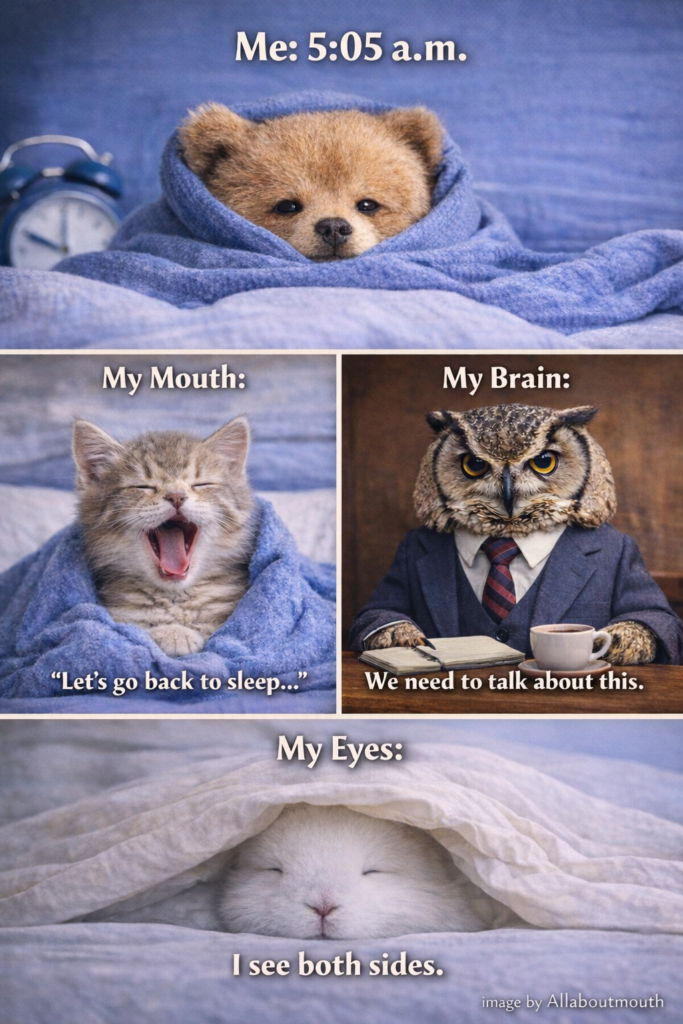
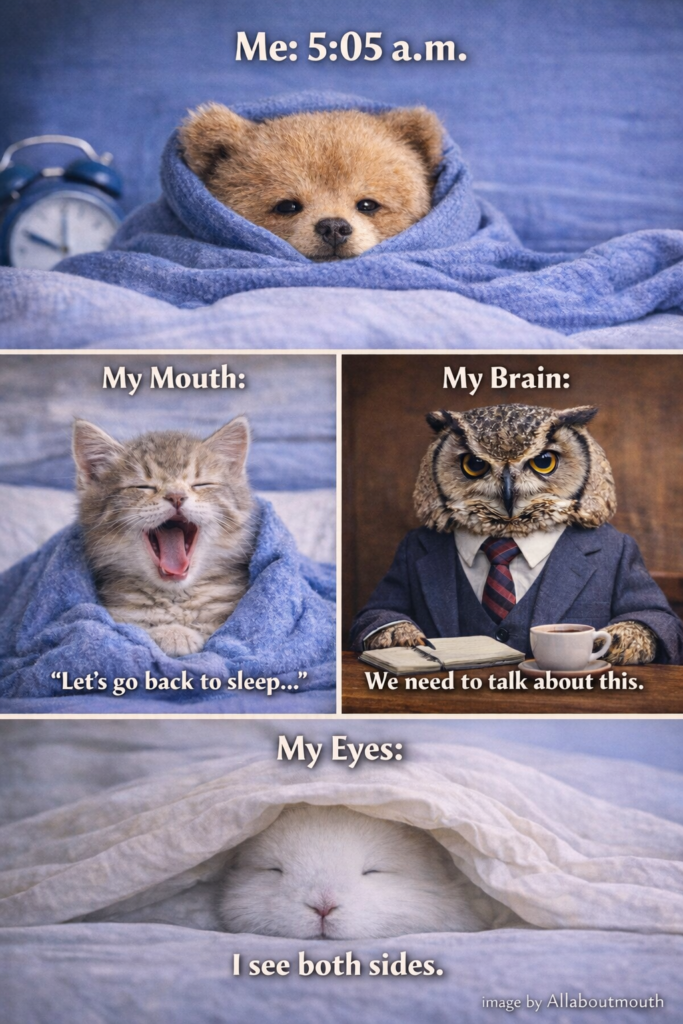
    My alarm goes off at five.
    I wake up around 5:05.

    By then, my mouth is already yawning and calling a meeting.

    Of course, the brain runs meetings.
    That’s understood.

    The problem is that this meeting isn’t about planning the morning.
    It’s about persuading the version of me from last night.

    Yawning is a signal.
    A physical one.
    Not ready yet.

    The brain understands the signal.
    And opens the meeting anyway.
    A meeting with a conclusion already in place.

    The agenda is always the same.
    Going back to sleep.

    “Just a little more.”
    “Meditation counts.”

    At this point, the eyes quietly support the motion.

    Sure.
    Eyes closed.
    Five more minutes of meditation.

    The mouth doesn’t decide.
    It just yawns.
    The eyes nod politely,
    and the brain treats this as a perfectly reasonable compromise.

    I sit on the bed with my eyes closed.
    This isn’t mindfulness.
    It’s not clarity either.
    It’s simply courtesy—
    acknowledging a conversation my body has already started.

    Five minutes pass.
    Five minutes isn’t much.
    But it’s enough to lose the morning.

    So I count: five, four, three, two, one.

    This isn’t discipline.
    It’s how the meeting ends.

    5:15 a.m.
    Not a complete victory.
    But maybe 85–90 percent.
    For a morning, that’s acceptable.

    I walk Minki.
    Take out the trash.
    Start the laundry.

    6:39 am

    The mouth is quieter.
    The eyes are fully open now.
    Yawning has stopped.
    Breathing has returned.

    That’s usually how I know
    the system is back online.

    And that’s enough for today.

    5분의 굴레, 혹은 아침의 입

    아침 5시 알람이 울린다.
    눈은 5시 5분쯤 떴다.

    그때쯤이면 입은 이미 하품을 하며 회의를 소집한다.

    물론, 회의를 여는 건 뇌다.
    항상 그렇다.

    다만 문제는 이 회의가 아침을 설계하려는 자리가 아니라,
    전날의 나를 설득하려는 회의라는 점이다.

    하품은 신호다.
    아직 하루를 시작할 준비가 안 됐다는,
    아주 물리적인 신호.

    뇌는 그 신호를 알아듣는다.
    그리고 회의를 연다.
    이미 결론이 정해진 회의를.

    의제는 늘 같다.
    다시 눕는 문제.

    “조금만 더.”
    “명상도 중요하지.”

    이때 눈은 옆에서 거든다.

    그래,
    눈 감은 채로
    5분만 더 명상해도 되잖아?

    아침의 입은 결정을 내리지 않는다.
    그저 하품을 한다.
    눈은 조심스럽게 동의하고,
    뇌는 그걸 꽤 합리적인 합의안으로 받아들인다.

    나는 눈을 감고 침대에 앉아 명상을 한다.
    마음을 비우려는 건 아니다.
    생각을 정리하려는 것도 아니다.
    그저 몸이 이미 시작한 대화에 예의를 갖추고 싶다.

    5분이 흐른다.
    5분은 짧다.
    하지만 다시 자기에 충분하다.

    그래서 숫자를 센다.
    5. 4. 3. 2. 1

    이건 결심이라기보다는
    회의를 중단시키는 방법에 가깝다.

    5시 15분.
    완전한 승리는 아니다.
    하지만 85–90%쯤이면
    아침으로선 나쁘지 않다.

    Minki와 산책을 하고,
    쓰레기를 내놓고,
    빨래를 돌린다.

    6시 39분.

    입은 조용해졌다.
    눈은 이제 제대로 뜨였고,
    하품 대신 숨이 돌아왔다.

    몸이 하나로 연결되어 있다는 사실은
    대개 이런 식으로 알게 된다.

    그 정도면
    오늘은 충분하다.

  • The Geography of Silence

    How a Piece of Plastic Brought Me Unexpected Peace

    I spend about half my year staring into other people’s mouths.

    They’re dark, damp, and occasionally still haunted by last night’s garlic.
    Anthropologically fascinating.
    Hygienically… ambitious.

    Every morning, I head into these small caves for work,
    like a very tired explorer who chose dentistry instead of the Himalayas.


    Silence Isn’t Golden. It’s a Relief.

    Most patients talk a lot once they sit in the dental chair.
    They explain how important their teeth are,
    how insurance is confusing,
    and how they are absolutely, unquestionably terrified.

    Then I place the mouth prop.

    And just like that—
    silence.

    Some people complain that certain countries are too quiet.
    I disagree.
    This kind of silence is beautiful.

    A mouth prop is the most effective tool ever invented
    to temporarily disable the human urge to explain things.

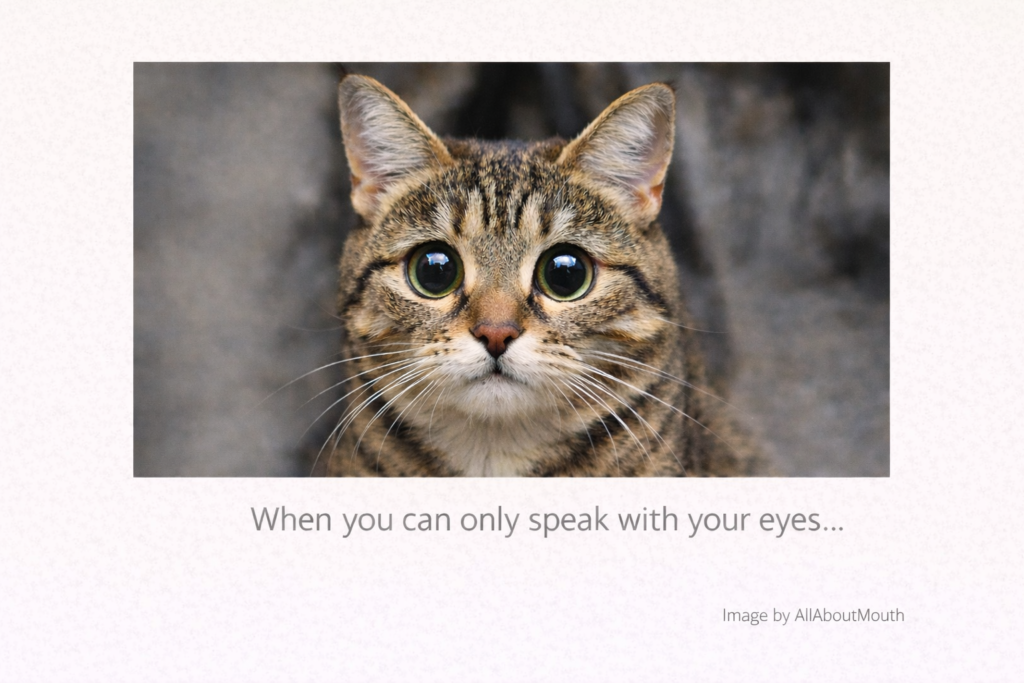
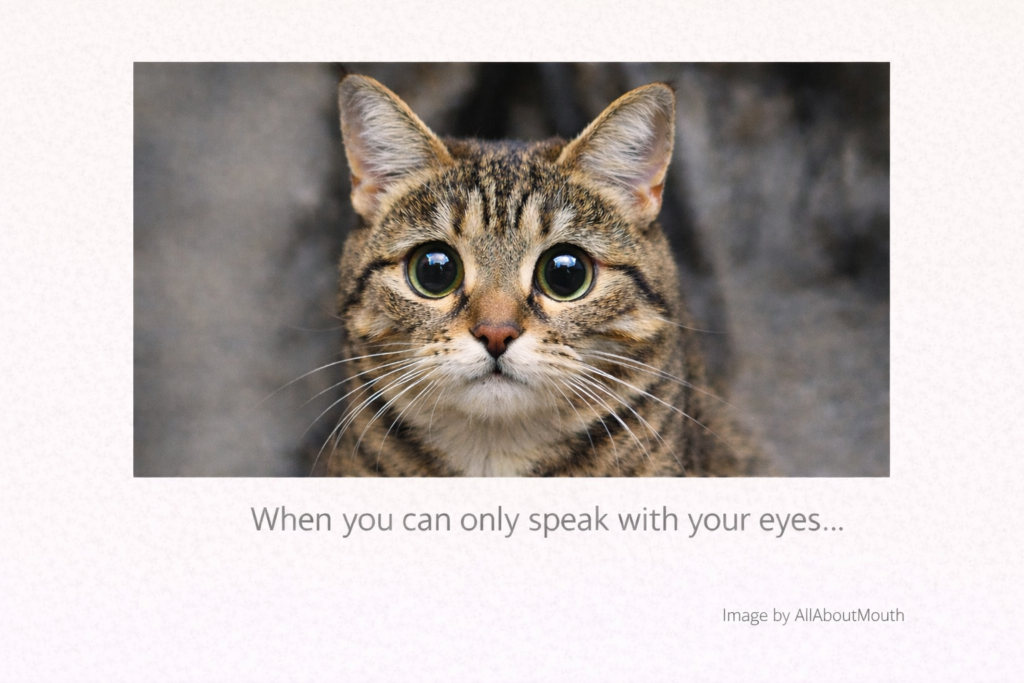
    At this point, patients communicate exclusively through eye contact.
    Their eyes say everything:
    “Doctor.”
    “Suction.”
    “Please.”

    That muffled uhhh–uhhh somehow feels more honest
    than a thousand perfectly articulated sentences.


    Spinach and the Collapse of Human Dignity

    Humans are terrible at silence.
    Put two strangers in an elevator,
    and within seconds someone will sacrifice dignity
    to fill the void with weather commentary.

    But the silence in a dental chair is different.
    It’s focused.
    Intentional.
    Slightly dramatic.

    People use their mouths to declare love and search for God,
    yet become completely powerless
    in the presence of a single piece of spinach
    stuck between their teeth.

    Spinach is not philosophical.
    It doesn’t care who you are.
    It simply exists—quietly dismantling your self-esteem.

    No matter how intelligent or mysterious your silence feels,
    a small green intruder between your molars
    will undo all of it.

    This is where dentistry teaches life lessons.
    Greatness doesn’t come from eloquent speeches.
    It comes from knowing when to shut your mouth
    and floss regularly.


    A Closed Mouth, An Open World

    Sometimes, after the procedure ends,
    patients stay quiet for a while.

    It might be the anesthesia.
    Or maybe their mouth is just enjoying a rare vacation.

    Lips that spend all day chewing, talking, and oversharing
    finally get a break.

    Some writers say happiness lives in connection.
    I sometimes find it in disconnection.

    When the mouth closes and the noise stops,
    something else becomes audible—
    your own voice.

    So today, ask yourself:
    how many spinach-level comments did your mouth release?

    If you’re tired of talking,
    consider giving your lips a short holiday.

    Just remember to check the mirror first—
    because silence only looks intelligent
    when there isn’t a piece of chili powder
    cheerfully waving hello from your front teeth.

    침묵의 지리학:개구기가 선사한 뜻밖의 평화

    나는 일 년의 절반을 타인의 입안을 들여다보며 보낸다.
    그곳은 축축하고 어두우며, 가끔은 어젯밤 그가 먹은 마늘의 흔적이 가시지 않은,
    인류학적으로는 매우 흥미롭지만 위생적으로는 다소 도전적인 장소다.

    나는 매일 아침, 환자들의 구강이라는 ‘작은 동굴’로 탐험을 떠난다.

    1. 침묵은 금이 아니라 ‘안도’다

    치과 진료실에 들어온 환자들은 대개 말이 많다.
    자신의 치아가 얼마나 소중한지, 보험 처리는 어떻게 되는지,
    그리고 지금 얼마나 무서운지(주로 이 부분이 핵심이다)를 쏟아낸다.

    하지만 내가 그들의 입에 개구기를 장착하는 순간,
    기적 같은 정적이 찾아온다.

    어떤 작가는 스위스 사람들이 너무 조용해서 미칠 것 같다고 투덜댔지만,
    나는 이 강제된 고요함이 꽤 사랑스럽다.
    개구기는 인간의 수다 본능을 잠재우는
    가장 확실한 물리적 차단기다.

    환자는 이제 오직 눈동자로만 말한다.
    그 눈동자에는
    “선생님, 저 석션 좀… 제발…”
    이라는 우주적인 고뇌가 담겨 있다.

    말로 하는 수천 마디보다
    그 간절한 ‘어버버’ 한 번이
    더 진실하게 느껴지는 건 왜일까.


    2. 시금치와 존재의 가벼움

    우리는 침묵을 잘 견디지 못하는 종족이다.
    엘리베이터 안에서 모르는 사람과 마주쳤을 때의 그 어색한 공백을 메우기 위해,
    우리는 날씨 이야기를 급히 쏟아낸다.

    하지만 진료실에서의 침묵은 다르다.
    그것은 ‘사건이 일어나기 직전의 폭풍전야’ 같은 침묵이다.

    사람들은 입으로 사랑을 맹세하고 신을 찾지만,
    정작 그 입안에 낀 시금치 한 조각 앞에서는 무력해진다.
    시금치는 철학적이지 않다.
    그것은 그저 거기 있을 뿐이다.

    아무리 고상한 침묵을 지켜도
    어금니 사이에 낀 초록색 이물질은
    당신의 모든 카리스마를 비웃는다.

    나는 거기서 인생의 진리를 배운다.
    인간의 위대함은 대단한 웅변이 아니라,
    적당한 때에 입을 닫고
    치실을 사용하는 부지런함에서 나온다는 사실을.


    3. 닫힌 입, 열린 세상

    가끔 진료가 끝난 뒤에도
    한동안 말을 하지 않는 환자가 있다.
    마취가 덜 풀려서일 수도 있지만,
    나는 그것을 ‘침묵의 휴가’라고 부르고 싶다.

    쉼 없이 무언가를 씹고, 말하고, 뱉어내던 입술이
    잠시 쉬어가는 시간.

    어떤 작가는 행복이 ‘연결’에 있다고 말했지만,
    나는 가끔 ‘단절’ 에서 행복을 찾는다.
    입을 닫음으로써 세상의 소음과 분리될 때,
    비로소 내 안의 목소리가 들리기 시작하기 때문이다.

    오늘 당신의 입은
    얼마나 많은 ‘시금치’ 같은 말’들을 쏟아냈는가.
    만약 수다에 지쳤다면,
    당신의 입술에 짧은 안식 휴가를 권한다.

    단, 입을 닫기 전에
    거울을 한 번 보는 것은 잊지 마라.
    당신의 침묵이 지적으로 보이려면,
    적어도 앞니에 낀 고춧가루가
    “까꿍!” 하고 인사를 건네지는 않아야 할 테니까.